/dev/artifacts
Artifact playground
Every artifact template with seeded variants. Must render crisply in both light and dark modes and match the params an agent would emit.
PolarityDiagram
MIG (solid core, gas shielded)
{"process":"mig"}Polarity setup — MIG (solid core, gas shielded)
Cable-to-socket mapping
- Ground clamp→Negative (−)
- Wire Feed Power→Positive (+)
- MIG gun→MIG gun socket
Flux-cored (gasless)
{"process":"flux_cored"}Polarity setup — Flux-Cored (gasless)
Cable-to-socket mapping
- Ground clamp→Positive (+)
- Wire Feed Power→Negative (−)
- MIG gun→MIG gun socket
TIG with socket highlight
{"process":"tig","highlight":"negative_socket"}Polarity setup — TIG
Cable-to-socket mapping
- Ground clamp→Positive (+)
- TIG torch→Negative (−)
Compare: MIG ↔ Flux-cored
{"process":"mig","compare_with":"flux_cored"}Polarity: MIG vs Flux-Cored
Cable-to-socket mapping
- Ground clamp→Negative (−)
- Wire Feed Power→Positive (+)
- MIG gun→MIG gun socket
- Ground clamp→Positive (+)
- Wire Feed Power→Negative (−)
- MIG gun→MIG gun socket
DutyCycleMatrix
Full matrix, no highlight
{}Duty cycle matrix
All processes · both input voltages
| 120V input | 240V input | |
|---|---|---|
| MIG / Flux-cored | Range30–140A Rated40% @ 100A 100%75A | Range30–220A Rated25% @ 200A 100%115A |
| TIG | Range10–125A Rated40% @ 125A 100%90A | Range10–175A Rated30% @ 175A 100%105A |
| Stick | Range10–80A Rated40% @ 80A 100%60A | Range10–175A Rated25% @ 175A 100%100A |
MIG at 200A on 240V
{"process":"mig","voltage":"240V","highlight_amps":200}Duty cycle matrix
Showing 200A 240V
| 120V input | 240V input | |
|---|---|---|
| MIG / Flux-cored | Range30–140A Rated40% @ 100A 100%75A | Range30–220A Rated25% @ 200A 100%115A |
| TIG | Range10–125A Rated40% @ 125A 100%90A | Range10–175A Rated30% @ 175A 100%105A |
| Stick | Range10–80A Rated40% @ 80A 100%60A | Range10–175A Rated25% @ 175A 100%100A |
TIG at 125A on 120V
{"process":"tig","voltage":"120V","highlight_amps":125}Duty cycle matrix
Showing 125A 120V
| 120V input | 240V input | |
|---|---|---|
| MIG / Flux-cored | Range30–140A Rated40% @ 100A 100%75A | Range30–220A Rated25% @ 200A 100%115A |
| TIG | Range10–125A Rated40% @ 125A 100%90A | Range10–175A Rated30% @ 175A 100%105A |
| Stick | Range10–80A Rated40% @ 80A 100%60A | Range10–175A Rated25% @ 175A 100%100A |
SettingsConfigurator
MIG 1/8" mild steel
{"process":"mig","material":"mild_steel","thickness":"1/8\""}Settings configurator
Synergic-style recommendation for MIG / GMAW
- Wire: 0.030" solid core.
- Polarity: DCEP — ground clamp to (−), wire feed cable to (+).
- Push angle 0-15° toward direction of travel. Keep CTWD ≤ 1/2".
Approximate starting values. The welder's Auto Weld mode computes exact synergic settings from the material + diameter you select on the LCD (see page 20).
Flux-cored 1/4" mild steel
{"process":"flux_cored","material":"mild_steel","thickness":"1/4\""}Settings configurator
Synergic-style recommendation for Flux-cored / FCAW
- Wire: 0.045" flux-cored, knurled feed roller.
- Polarity: DCEN — ground clamp to (+), wire feed cable to (−). REVERSED from MIG.
- Drag angle 0-15° away from direction of travel. The slag trails the puddle.
- Clean slag with chipping hammer + wire brush between passes.
Approximate starting values. The welder's Auto Weld mode computes exact synergic settings from the material + diameter you select on the LCD (see page 20).
TIG 0.062" stainless
{"process":"tig","material":"stainless_steel","thickness":"16 ga"}Settings configurator
Synergic-style recommendation for TIG / GTAW
- Tungsten: 1/16", 2% thoriated or lanthanated, sharpened to a point.
- DC TIG: ground clamp to (+), torch to (−).
- Foot pedal controls amperage in real time. Rule of thumb: ~1 A per thousandth of material thickness.
Approximate starting values. The welder's Auto Weld mode computes exact synergic settings from the material + diameter you select on the LCD (see page 20).
MIG aluminum (will show spool-gun caution)
{"process":"mig","material":"aluminum","thickness":"14 ga"}Settings configurator
Synergic-style recommendation for MIG / GMAW
- Wire: 0.030" solid core.
- Polarity: DCEP — ground clamp to (−), wire feed cable to (+).
- Push angle 0-15° toward direction of travel. Keep CTWD ≤ 1/2".
⚠Aluminum MIG needs the optional Spool Gun + 100% Argon. The main MIG gun with steel-rated liner will not feed soft aluminum reliably.
Approximate starting values. The welder's Auto Weld mode computes exact synergic settings from the material + diameter you select on the LCD (see page 20).
TroubleshootingTree
Porosity on flux-cored
{"symptom":"porosity","process":"flux_cored"}Troubleshooting decision tree
Flux-cored · "porosity"
Porosity in the Weld Metal
p43- Fix
Check gas bottle and replenish as necessary.
Bird nest on MIG
{"symptom":"bird nest","process":"mig"}Troubleshooting decision tree
MIG · "bird nest"
Wire Creates a Bird's Nest During Operation
p42- Fix
Adjust wire feed pressure properly. Follow step 27 on page 17.
Weak arc on stick
{"symptom":"weak arc","process":"stick"}Troubleshooting decision tree
Stick · "weak arc"
Weak Arc Strength
p44- Fix
Check the line voltage and, if insufficient, have a licensed electrician remedy the situation.
ProceduralWalkthrough
MIG cable setup
{"topic":"cable_mig"}MIG cable setup
Solid-core wire with shielding gas — DCEP polarity
Plug ground clamp into the negative (−) socket
Twist clockwise all the way to lock. Ground clamp goes to the workpiece or a grounded metal bench.

Flux-cored cable setup
{"topic":"cable_flux"}Flux-cored cable setup
Self-shielded, gasless wire — DCEN polarity (reversed from MIG)
Plug ground clamp into the POSITIVE (+) socket
This is the opposite of MIG. If you ran solid wire last and leave it plugged into negative, your flux-cored welds will be full of porosity.
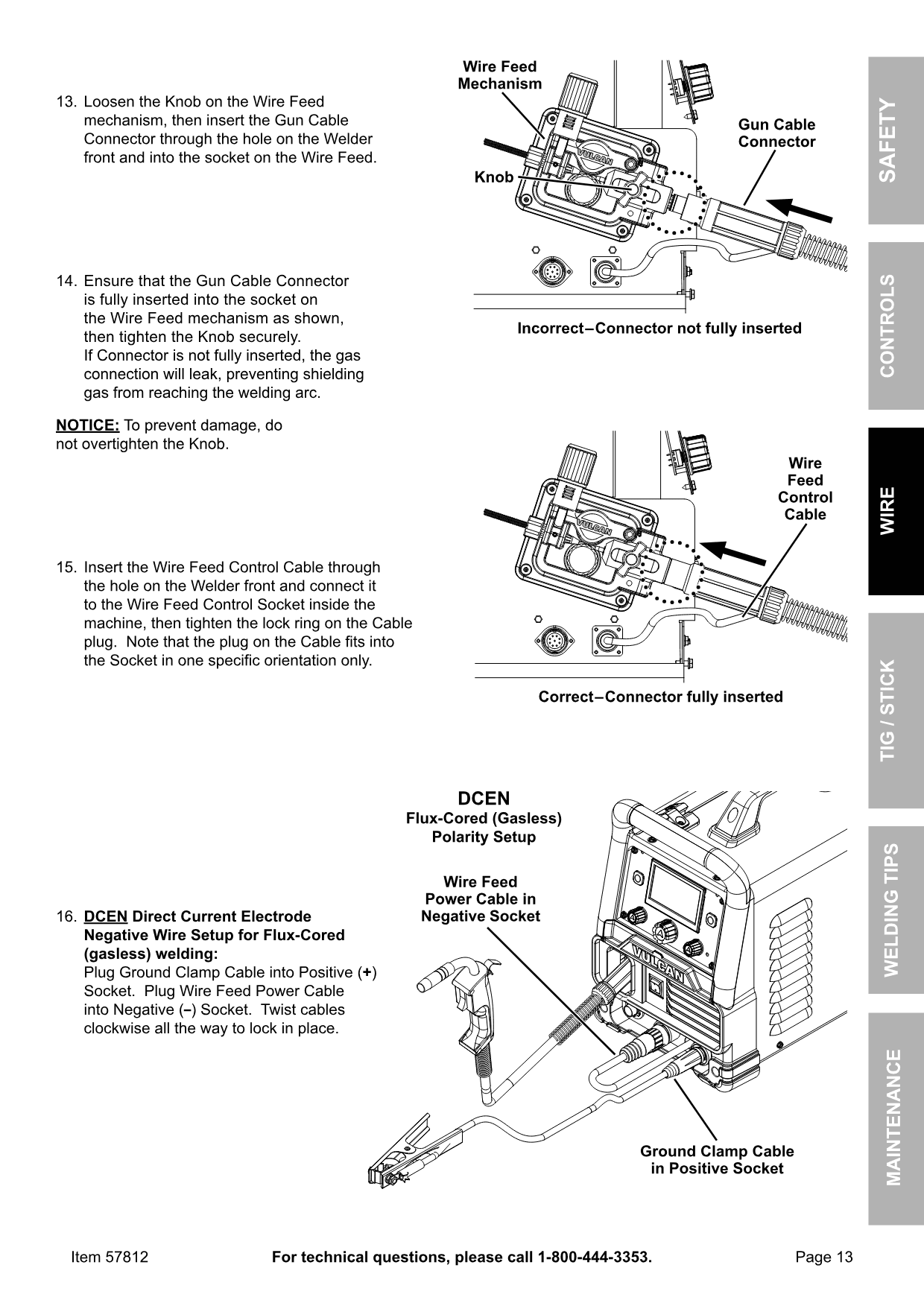
TIG cable setup
{"topic":"cable_tig"}TIG cable setup
DC TIG, ground → positive, torch → negative
Plug ground clamp into POSITIVE (+)
TIG runs DCEN for steel and stainless — electrode (torch) is negative.

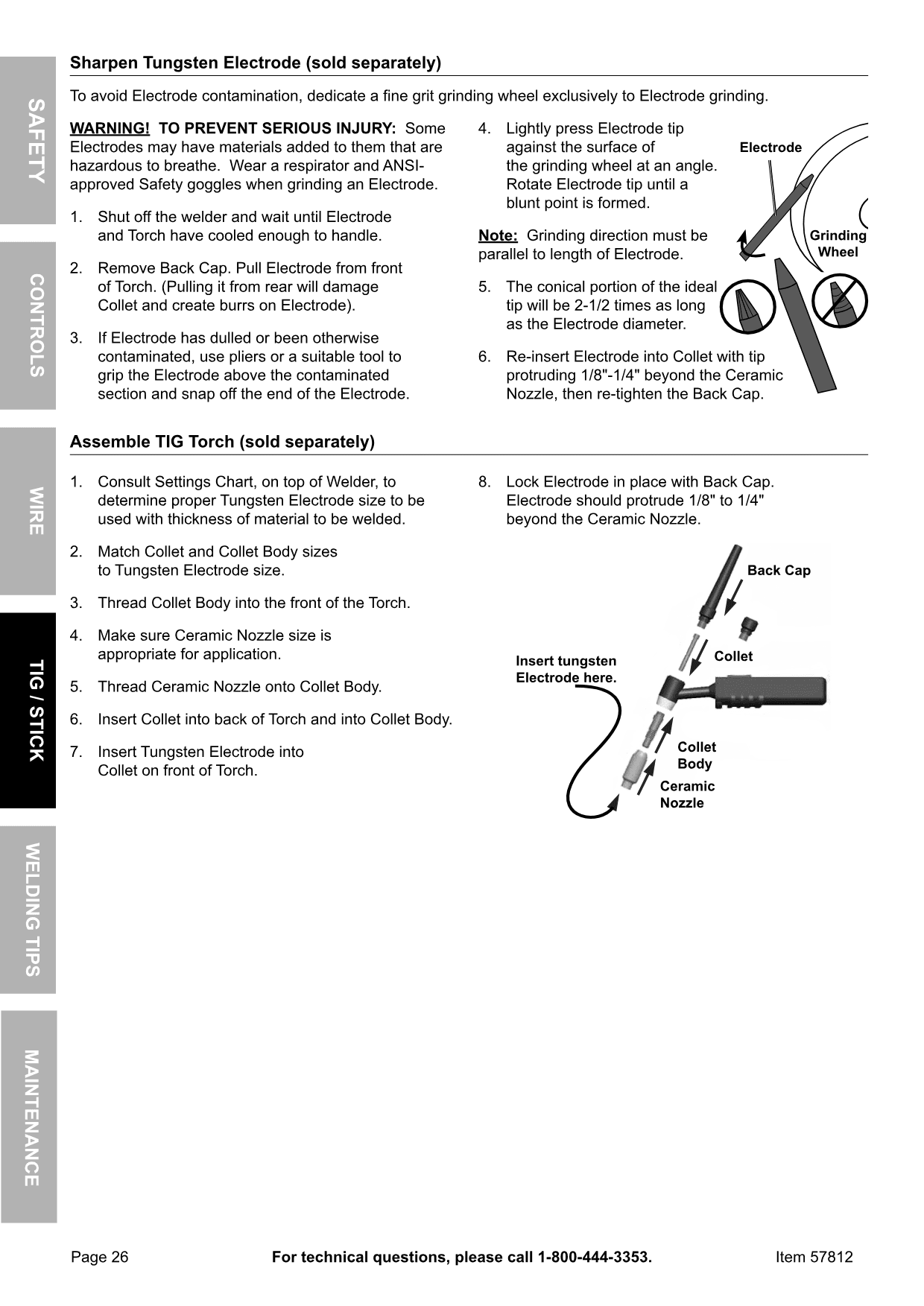
Tungsten sharpening
{"topic":"tungsten_sharpen"}Sharpen a tungsten electrode
Pointed tip for DC TIG on steel; balled tip for AC on aluminum
Shut off the welder and let the electrode cool
Tungsten is still hot for a while after welding.
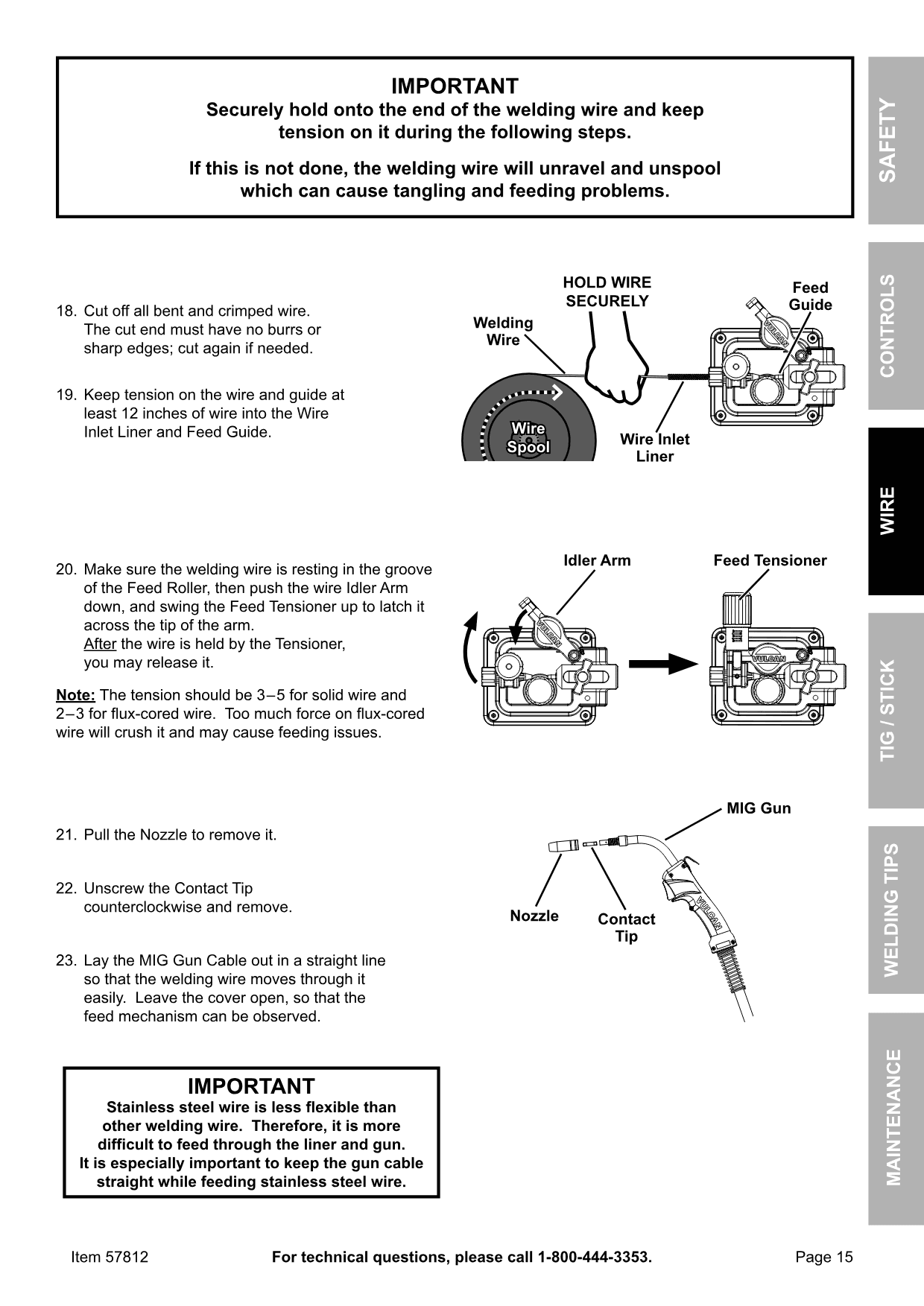
Feed tension
{"topic":"feed_tension_set"}Set wire-feed tension
Right tension feeds cleanly; wrong tension birdnests or crushes
Loosen the feed tensioner knob
Turn counterclockwise until the idler arm can swing freely.
ComponentHighlight
Positive socket on front panel
{"figure_id":"front-panel-controls","part_name":"positive socket"}positive socket
Located on: Front Panel Controls diagram showing all buttons, knobs, sockets, and switches
Other labeled parts on this figure: front panel, LCD display, home button, back button, control knob, left knob.
Power switch on front panel
{"figure_id":"front-panel-controls","part_name":"power switch"}power switch
Located on: Front Panel Controls diagram showing all buttons, knobs, sockets, and switches
Other labeled parts on this figure: front panel, LCD display, home button, back button, control knob, left knob.
Feed tensioner (non-panel figure)
{"figure_id":"interior-controls","part_name":"feed tensioner"}feed tensioner
Located on: Interior Controls showing wire feed mechanism, spool, tensioner, and internal sockets
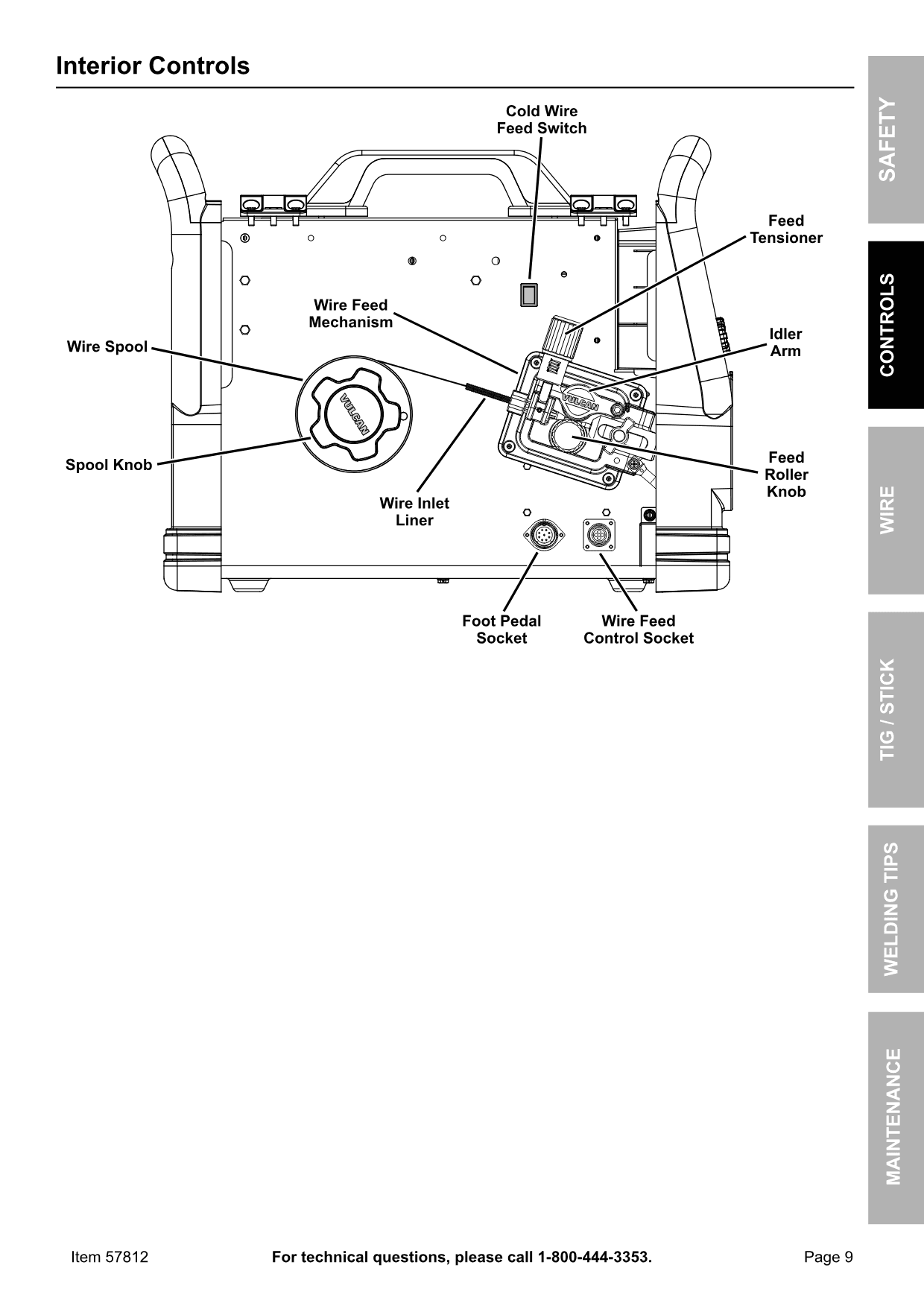
Other labeled parts on this figure: interior, wire spool, spool knob, wire feed mechanism, idler arm, feed roller knob.
SelectionChartInteractive
No prefilled filters
{}Process selection chart
The door-sticker decision tree — filter by what you have and see which processes fit.
Flux-cored
FCAWAdvantages
- Ideal for outdoor or windy conditions
- Forgiving on rusty or dirty steels
- Good out of position welding capabilities
- High deposition rates achievable
MIG
GMAWAdvantages
- Fast production (high welding speeds)
- Easiest to learn
- Clean welds with no slag
- Better control on thin materials
Stick
SMAWAdvantages
- Ideal for outdoor or windy conditions
- Forgiving on rusty or dirty steels
- Deep penetration
- Good choice for thicker materials
TIG
GTAWAdvantages
- Highest quality welds
- Extremely aesthetic weld appearance
- Can be used on a variety of materials
- Precise control
Prefilled: aluminum, 3/8", no gas
{"prefilled":{"material":"aluminum","thickness_inches":0.375,"gas_available":false}}Process selection chart
The door-sticker decision tree — filter by what you have and see which processes fit.
Flux-cored
FCAWAdvantages
- Ideal for outdoor or windy conditions
- Forgiving on rusty or dirty steels
- Good out of position welding capabilities
- High deposition rates achievable
MIG
GMAWAdvantages
- Fast production (high welding speeds)
- Easiest to learn
- Clean welds with no slag
- Better control on thin materials
Stick
SMAWAdvantages
- Ideal for outdoor or windy conditions
- Forgiving on rusty or dirty steels
- Deep penetration
- Good choice for thicker materials
TIG
GTAWAdvantages
- Highest quality welds
- Extremely aesthetic weld appearance
- Can be used on a variety of materials
- Precise control
WeldComparison
Porosity (top match) + spatter runner-up
{"catalog_id":"wire_porosity","runner_up_id":"wire_excessive_spatter"}user_image_url auto-injected in the real chat; shows placeholder here.
Weld photo diagnosis
Matched against the manual's labeled reference catalog
No image attached in this turn. Upload a photo of the defect to compare.
What to look for in the reference
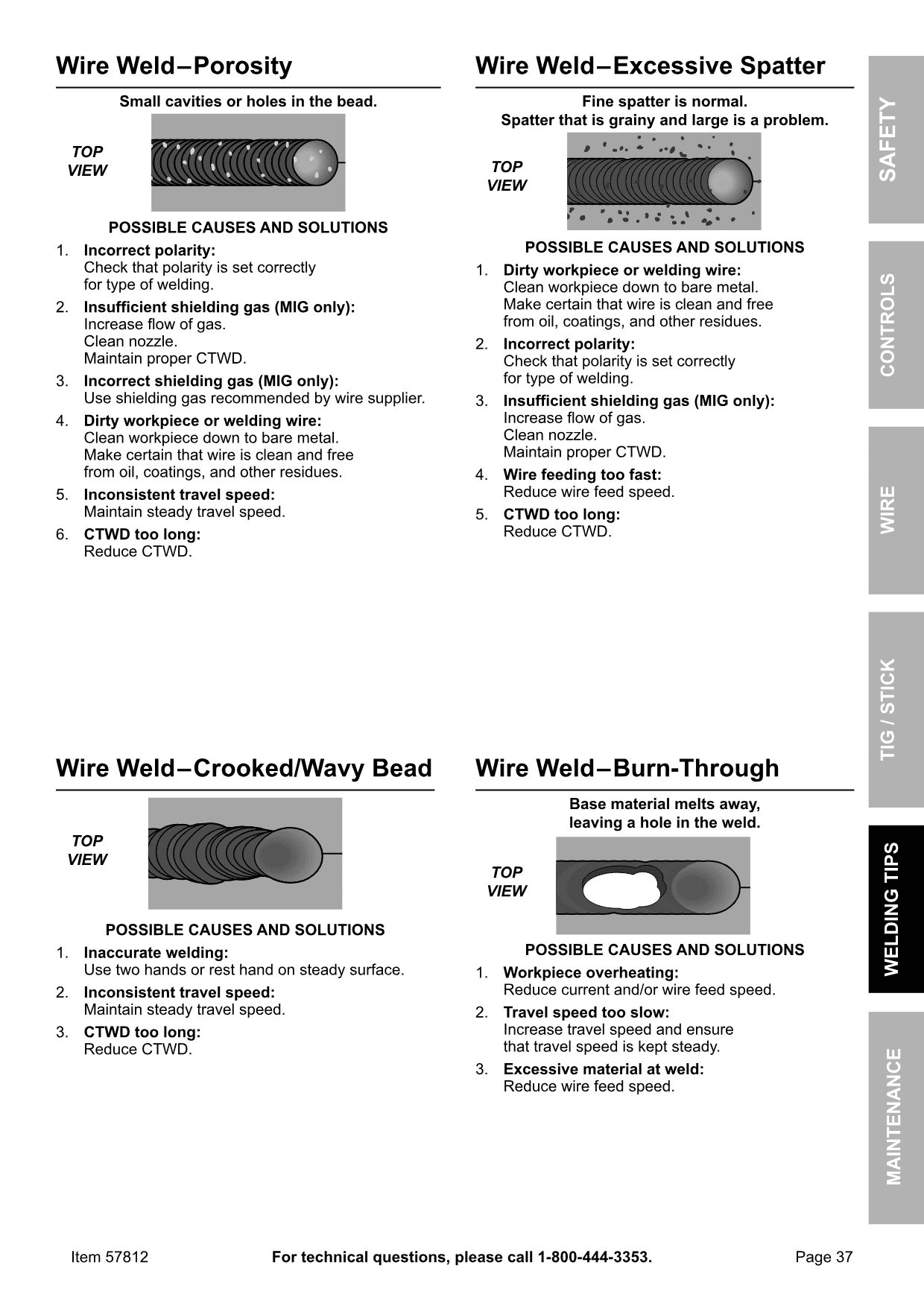
Top view of a bead with small round holes and pits (cavities) scattered across its surface, giving a pock-marked or Swiss-cheese appearance. The ripple pattern is otherwise normal, but gas bubbles have left craters in the crown of the weld.
Fix
Check polarity/gas/CTWD and clean the workpiece and wire.
- Verify polarity is correct for type of welding.
- Increase shielding gas flow; clean nozzle; maintain proper CTWD.
- Use shielding gas recommended by wire supplier.
- Clean workpiece down to bare metal; ensure wire is free of oil and residue.
- Maintain steady travel speed.
- Reduce CTWD.
Not quite right? Runner-up: Wire Weld — Excessive Spatter (p37)
Top view of a bead surrounded by a heavy scattering of large, coarse, grainy spatter balls along both sides of the weld. The spatter is much larger and more abundant than the fine dusting considered normal — clearly visible droplets stuck to the base metal.
Clean parts, verify polarity and gas, reduce wire speed and CTWD.
Stick current too high
{"catalog_id":"stick_current_too_high"}Weld photo diagnosis
Matched against the manual's labeled reference catalog
No image attached in this turn. Upload a photo of the defect to compare.
What to look for in the reference
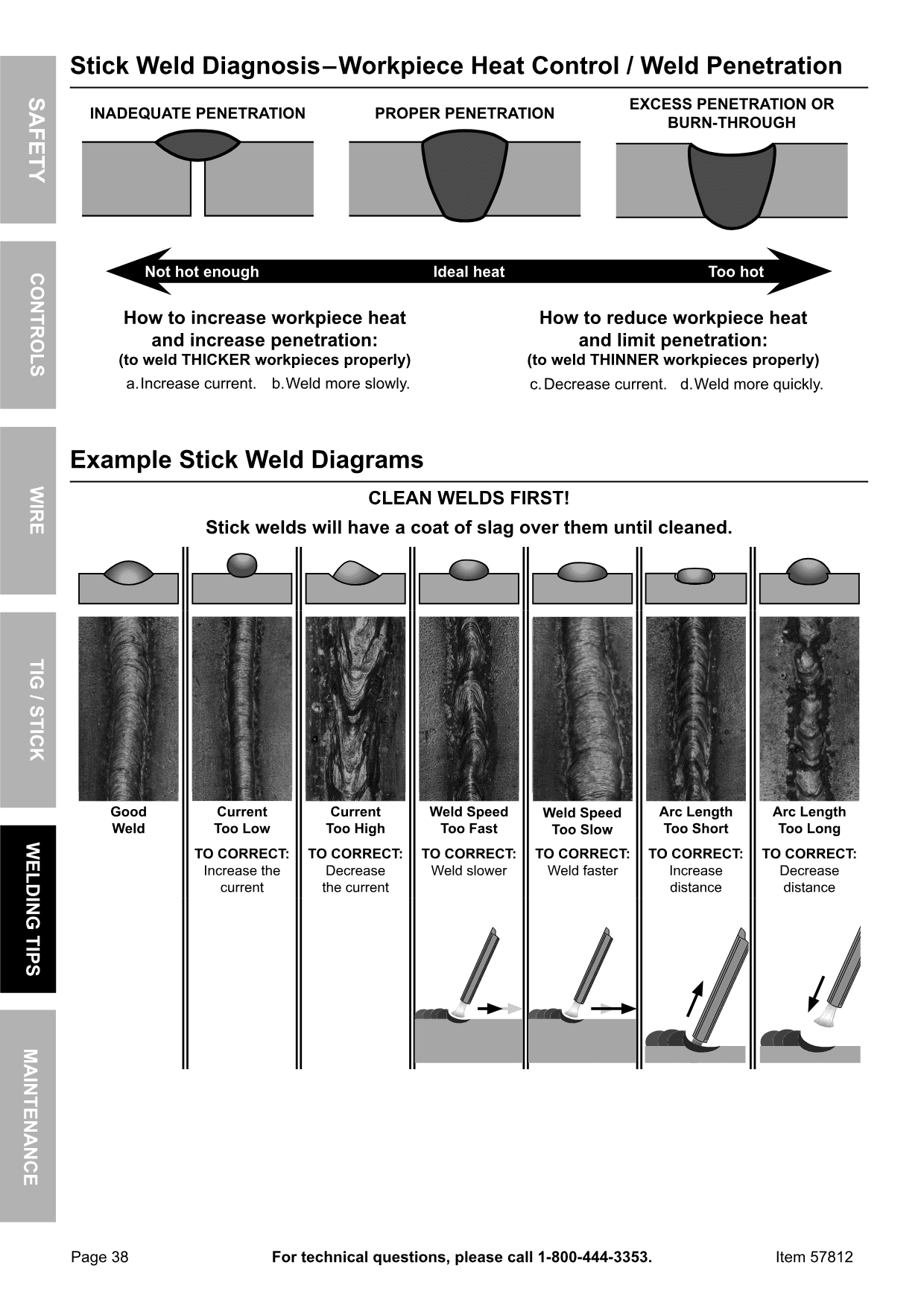
Wide, flat stick bead with heavy distortion and a rough, rippled, burnt-looking surface. The surrounding plate shows a large discolored heat-affected zone. Bead may show undercut along the edges and an irregular, violent ripple pattern.
Fix
Decrease the current.
- Decrease weld current.